
Zero-Knowledge Proofs in Action: How Businesses Are Turning Cryptographic Theory into Competitive Advantage
Wed, Mar 25, 2026 •10 min read
In the rapidly evolving landscape of digital trust, one of the most pressing challenges businesses face is surprisingly paradoxical: how do you prove something without revealing the information that proves it? For years, companies have been forced to choose between privacy and verifiability - exposing sensitive data to auditors, partners, or regulators just to demonstrate compliance or eligibility. But that trade-off is quickly becoming obsolete. Zero-knowledge proofs (ZKPs) are emerging as one of the most powerful cryptographic tools of our era, enabling businesses to verify facts without disclosing the underlying data at all.
In today's post, we take a close look at how ZKPs work, where they're already creating real business value, and what it takes to implement them right. Here's the content breakdown:
- What is a zero-knowledge proof?
- Must-know ZKP stats
- Where ZKPs are delivering real-world results
- What challenges should you be prepared for?
- Why the team behind your ZKP project makes all the difference
What Is a Zero-Knowledge Proof? A Business-First Explanation
Picture this: your company needs to prove to a financial regulator that your transaction volumes meet a specific threshold - without exposing your full transaction history. Or imagine a healthcare provider needing to confirm a patient's eligibility for a clinical trial without sharing any personal medical records. These aren't hypothetical scenarios. They're exactly the kind of problems ZKPs were built to solve.
At its core, a zero-knowledge proof is a cryptographic method that allows one party - the prover - to demonstrate to another party - the verifier - that a statement is true, without conveying any information beyond the truth of that statement itself. The technology maintains three fundamental properties: completeness (valid proofs are always accepted), soundness (invalid proofs are always rejected), and zero-knowledge (no information beyond the validity of the statement is ever revealed).
The most common ZKP variants businesses encounter today are zk-SNARKs (Succinct Non-interactive Arguments of Knowledge) and zk-STARKs (Scalable Transparent Arguments of Knowledge). Both allow for the verification of complex computations off-chain, with only a compact cryptographic proof submitted to the blockchain - making them invaluable for applications that demand both privacy and scalability.
Must-Know ZKP Stats: The Numbers Behind the Technology
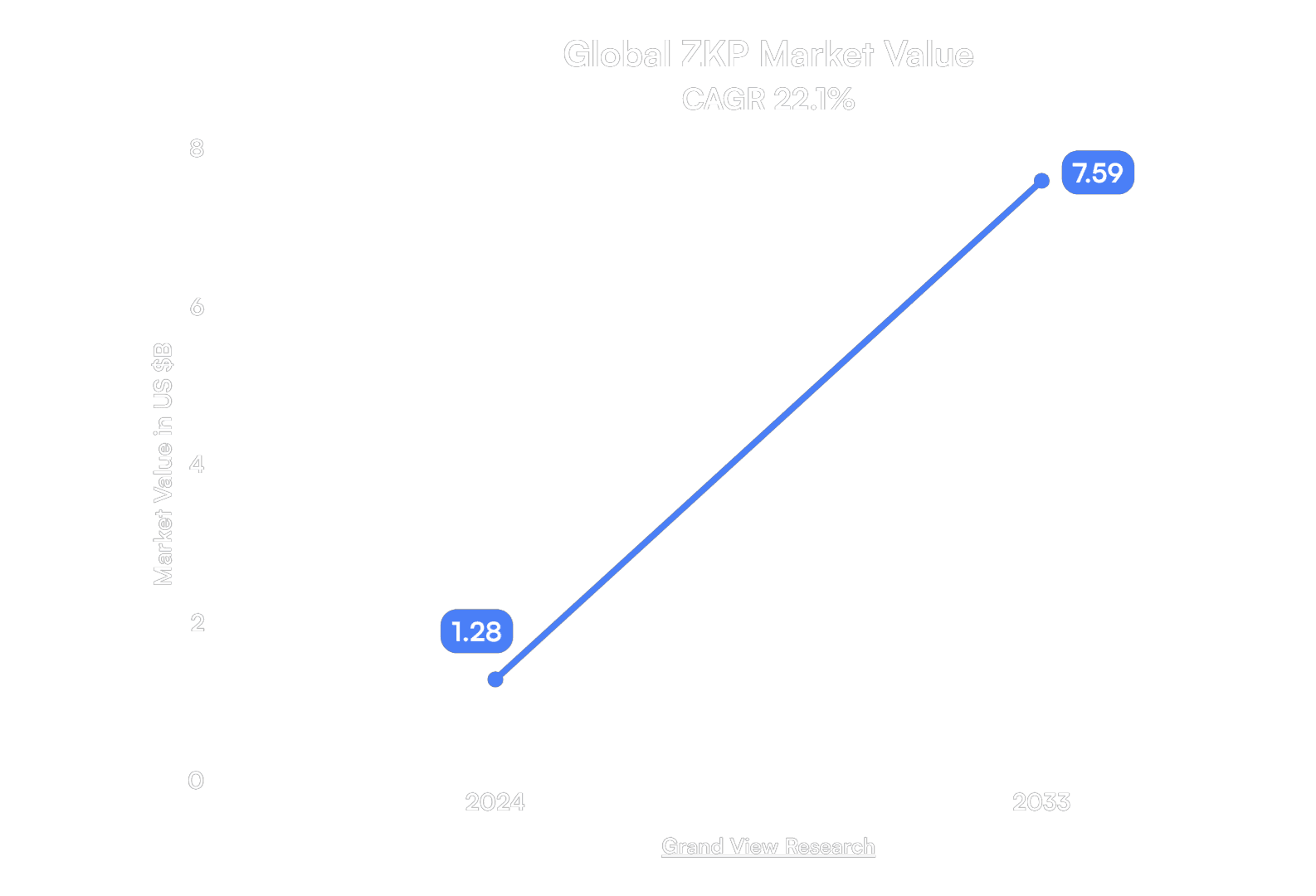
Let's start with some numbers to put the momentum behind ZKPs in perspective. The global zero-knowledge proof market, valued at approximately $1.28 billion in 2024, is projected to reach $7.59 billion by 2033, growing at a compound annual rate of 22.1% (Grand View Research). This isn't just a niche blockchain phenomenon - the BFSI (banking, financial services, and insurance) sector currently accounts for the largest share of ZKP adoption, followed by government, healthcare, and retail.
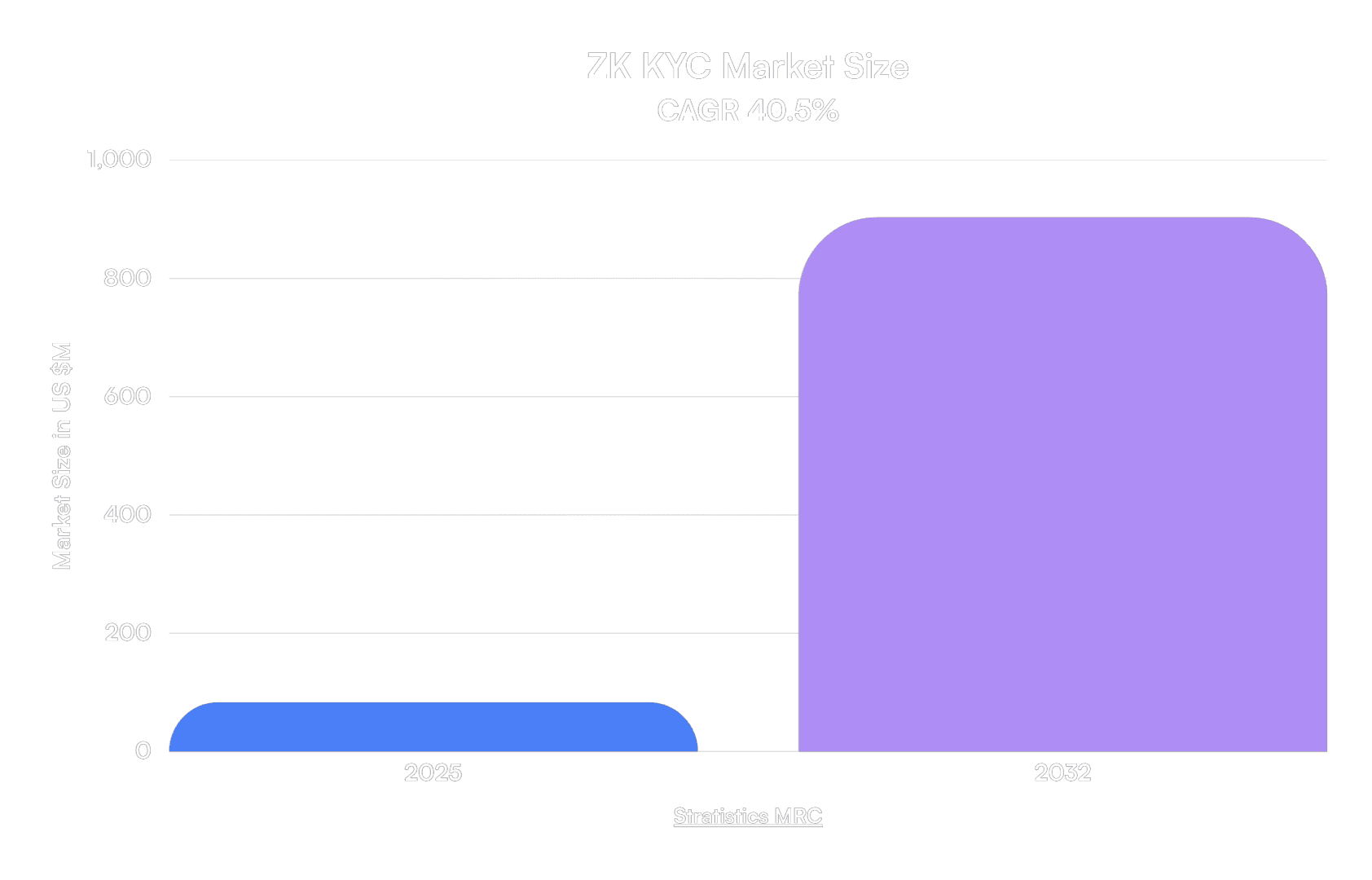
Perhaps even more striking: as of 2025, the Ethereum Layer 2 ecosystem - powered largely by ZK rollup infrastructure - reached a peak of $47 billion in Total Value Locked in October 2025 (L2Beat). ZK rollups specifically account for around $3.3 billion of that, with the broader L2 ecosystem built on top of ZK-proof security guarantees continuing to grow rapidly. That's not research funding or venture capital, that's real capital sitting in operational systems right now. And the ZK-based KYC market alone is growing at 40.5% CAGR, from $83.6 million in 2025 to a projected $903.5 million by 2032 (Stratistics MRC). That last figure is particularly significant for companies dealing with identity and compliance. It tells you where the industry is heading before the regulatory mandates arrive.
Where ZKPs Are Delivering Real-World Results
Financial Services and DeFi: Privacy at Scale
The financial sector has become the most active proving ground for ZKP technology - and for good reason. Financial institutions need to verify transaction authenticity and customer credentials without exposing sensitive data. That's precisely what ZKPs enable at scale. Take Loopring, a decentralized exchange built on ZK rollups. During periods of severe Ethereum network congestion in 2024, when mainnet transaction fees exceeded $50 per transaction, Loopring users continued trading with fees under $0.50, maintaining identical security guarantees while achieving near-instant execution. A quantitative trading firm that migrated to Loopring reported a 94% reduction in monthly trading costs, transforming previously unprofitable high-frequency strategies into viable operations.
Similarly, when Aave, one of the largest DeFi lending protocols, deployed on Scroll (a ZK-powered Layer 2), the migration required zero contract modifications. Integration took hours instead of the weeks typically required for other Layer 2 solutions, and users experienced transaction cost reductions of over 95% with no change to the interface or functionality.
Real-Life Use Case: Private Payroll and B2B Payments
In September 2025, Aleo Network integrated with Request Finance to enable confidential on-chain payroll and vendor payments using zero-knowledge cryptography. Companies can now conduct compliant business transactions, including employee payroll, on-chain while maintaining full data privacy. This solves a problem that has blocked many enterprises from adopting blockchain-based financial infrastructure: the tension between regulatory compliance and business confidentiality.
Identity Verification: Prove Who You Are Without Showing Who You Are
Traditional KYC processes force users to hand over passports, utility bills, and financial statements to multiple parties, creating enormous data liability on both sides. ZKP-based identity systems fundamentally reframe this interaction. With zero-knowledge decentralized identifiers, a user can prove they're over 18, a resident of a specific country, or an accredited investor without revealing their birthdate, address, or account balance. The credentials are stored by the user themselves, and each proof discloses only the minimum required information. For DeFi platforms that need to enforce regulatory requirements, this unlocks a path to compliance without custodial data collection.
Aztec Network, backed by $100 million in funding led by a16z crypto, is building what it describes as the first hybrid ZK rollup, combining private transaction encryption with ZK-proof compression. The result: fully private smart contracts on Ethereum, where business logic can execute without exposing any underlying data to other network participants.
Supply Chain and Carbon Markets: Verifying Without Exposing
Supply chains present a particularly rich opportunity for ZKPs. Companies are routinely required to share supplier data, sourcing information, and logistics records with partners, auditors, and regulators - data that also happens to represent their most valuable competitive intelligence. ZKPs allow businesses to share verified insights without giving competitors a window into their operations.
In the carbon credit market, this problem has reached critical proportions. Senken's decentralized carbon marketplace uses ZKPs to enable end-to-end accountability for authentic carbon credits, allowing enterprises to verify the provenance of credits they purchase privately, and publish their carbon consumption and savings data, without exposing commercial relationships. With over 100 high-quality carbon projects on the platform, ZKPs are helping bridge the gap between a supply of 400 million tonnes and demand of 420 billion metric tonnes, in a market plagued by authenticity concerns.
Intellectual Property Management: A Rumble Fish Case Study
One of the most technically ambitious real-world ZKP deployments we've built ourselves demonstrates just how transformative this technology can be when implemented by a team that genuinely understands both the cryptography and the business context.
Real-Life Use Case: Original Works — Decentralized IP Registry
Original Works, a foundation incubated by Revelator (a leader in music rights management and digital distribution), needed to bring the DDEX standard (the global protocol for exchanging music metadata between labels, distributors, and publishers) onto the blockchain. The challenge: DDEX messages use a complex XML format with over 50,000 lines of validation rules. Validating these on-chain was computationally impossible within Ethereum's gas limits.
Our team at Rumble Fish engineered a bespoke network of ZK-powered validators using the RISC Zero virtual machine, writing validation logic in Rust and generating zero-knowledge proofs for each XML file's correctness. The initial proof generation time was 16 hours per file - far too slow for a system processing thousands of messages daily. Through rigorous optimization, including GPU acceleration and preprocessing raw XML into JSON, we cut proof generation time from 16 hours to just 3 minutes.
The result: a fully decentralized, tamper-proof, and automated system for validating and registering music IP metadata, with complete auditability and no centralized point of failure. "The innovative solutions developed by the Rumble Fish team were instrumental in overcoming the complex challenges of bringing DDEX metadata to the blockchain," said Gilad Woltsovitch, Co-Founder of Original Works. “This collaboration exceeded all our expectations.”
What Challenges Should You Prepare For?
That said, zero-knowledge proof development comes with unique challenges that can become serious bottlenecks if your implementation team doesn't have deep, hands-on experience with the technology. Here's where things get genuinely complex.
- Computational intensity. Generating ZK proofs, particularly for complex computations, can be extremely resource-heavy. Our Original Works project is a clear example: raw proof generation took 16 hours before systematic optimization brought it to 3 minutes. Without the right expertise in hardware acceleration, zkVMs, and proof system selection, teams can find themselves with technically correct but operationally impractical systems.
- Trusted setup requirements. Some ZKP schemes (notably zk-SNARKs) require a trusted setup ceremony - a multi-party computation process that generates the initial cryptographic parameters. If this process is compromised, the entire system's integrity is at risk. Managing this correctly demands specialized cryptographic knowledge that goes well beyond standard blockchain development.
- Circuit design complexity. In ZKP systems, the computation you want to prove must be expressed as an arithmetic circuit, a highly specialized representation that requires deep expertise in both the target problem and the underlying cryptographic machinery. Errors in circuit design can introduce subtle vulnerabilities that are difficult to detect and costly to fix post-deployment.
- Integration with existing systems. Most enterprise environments have established data formats, workflows, and compliance requirements, like the DDEX XML standard in our Original Works project. Integrating ZKP systems with legacy infrastructure without disrupting existing operations requires both cryptographic and systems engineering expertise working in close coordination.
Gaining a competitive edge with ZKPs requires understanding, predicting, and planning for these obstacles from day one. The good news is that with the right team, none of them are insurmountable.
Why the Team Behind Your ZKP Project Makes All the Difference
Here's where the stakes become very real for CTOs and technical decision-makers. Zero-knowledge proof development sits at the intersection of cutting-edge cryptography, blockchain engineering, performance optimization, and domain expertise. It is not a space where generalist blockchain developers can improvise their way to production-quality results.
The difference between a team that has shipped ZKP systems in production and one that is learning on your project is measured not in code quality metrics, but in 16-hour proof generation times versus 3-minute ones. In systems that hold up under real transaction volumes versus those that collapse under load. In security models that are mathematically sound versus those that appear correct but harbor subtle vulnerabilities. And we all know that being the first to bring a privacy-preserving product to market in your sector builds a massive competitive advantage, particularly in financial services, healthcare, and supply chain, where data privacy is rapidly becoming a regulatory baseline, not a differentiator.
What to look for in a ZKP development partner:
- Production track record - not just research papers or proof-of-concepts, but shipped systems operating under real load
- Protocol agnosticism - the ability to select the right ZKP scheme (SNARKs, STARKs, or hybrid approaches) for your specific use case, not a single preferred tool
- End-to-end ownership - from cryptographic protocol design through backend proving services, smart contract verification, and frontend integration
- Deep familiarity with zkVMs (like RISC Zero) and performance optimization, especially GPU acceleration for proof generation
- Honest, engineering-first communication with realistic timelines
The Window Is Open - But Not Forever
In the early days of blockchain, ZKPs were a subject for academic papers and cryptography conferences. Today, they are live infrastructure securing tens of billions of dollars of value, enabling private enterprise transactions, and powering the next generation of identity and compliance systems. The technology has been battle-tested, the tooling has matured dramatically, and the business case has never been clearer. The question for technology leaders is no longer whether zero-knowledge proofs are ready for production. They are. The question is whether your organization will be among those that capture the privacy, scalability, and compliance advantages of this technology in the next 12 to 24 months - or whether you'll be playing catch-up to competitors who moved sooner.
If you're evaluating ZKP adoption for your platform or exploring what a privacy-preserving architecture could look like for your specific use case, our team at Rumble Fish has the production experience to help you move from concept to deployment with confidence. Get in touch with us and let's explore what's possible.
Recent posts