
ZKP Development Companies in 2026: Who's Actually Building
Mon, Aug 3, 2026 •6 min read
By mid-2026, the ZKP industry had over $3 billion in total funding deployed; zkSync Era and Starknet are serving real transaction volume, Aztec launched on mainnet, and the proving layer, once a bottleneck that made production ZK feel impractical, has crossed into viable territory thanks to specialized prover infrastructure.
This list is not a directory of everyone experimenting with ZK. It focuses on companies that have shipped: production deployments, mainnet systems, or development services with verifiable client work. There are dozens of stealth projects claiming breakthroughs in proof efficiency. Most of them don't belong here yet.
What's changed in the last 18 months is the cost and speed of proof generation. In 2024, generating an Ethereum block proof required a $300–400K GPU cluster and hours of compute time. Today, Succinct's SP1 Hypercube brings that down to around 10 seconds on 16x RTX 5090s. RISC Zero's R0VM 2.0 went from 35 minutes to 44 seconds per block. Those are the numbers that unlock the next category of applications, and the companies below are the ones building on top of that shift.
Infrastructure: The Proving Layer
The least visible part of the ZK ecosystem is the one that makes everything else possible.
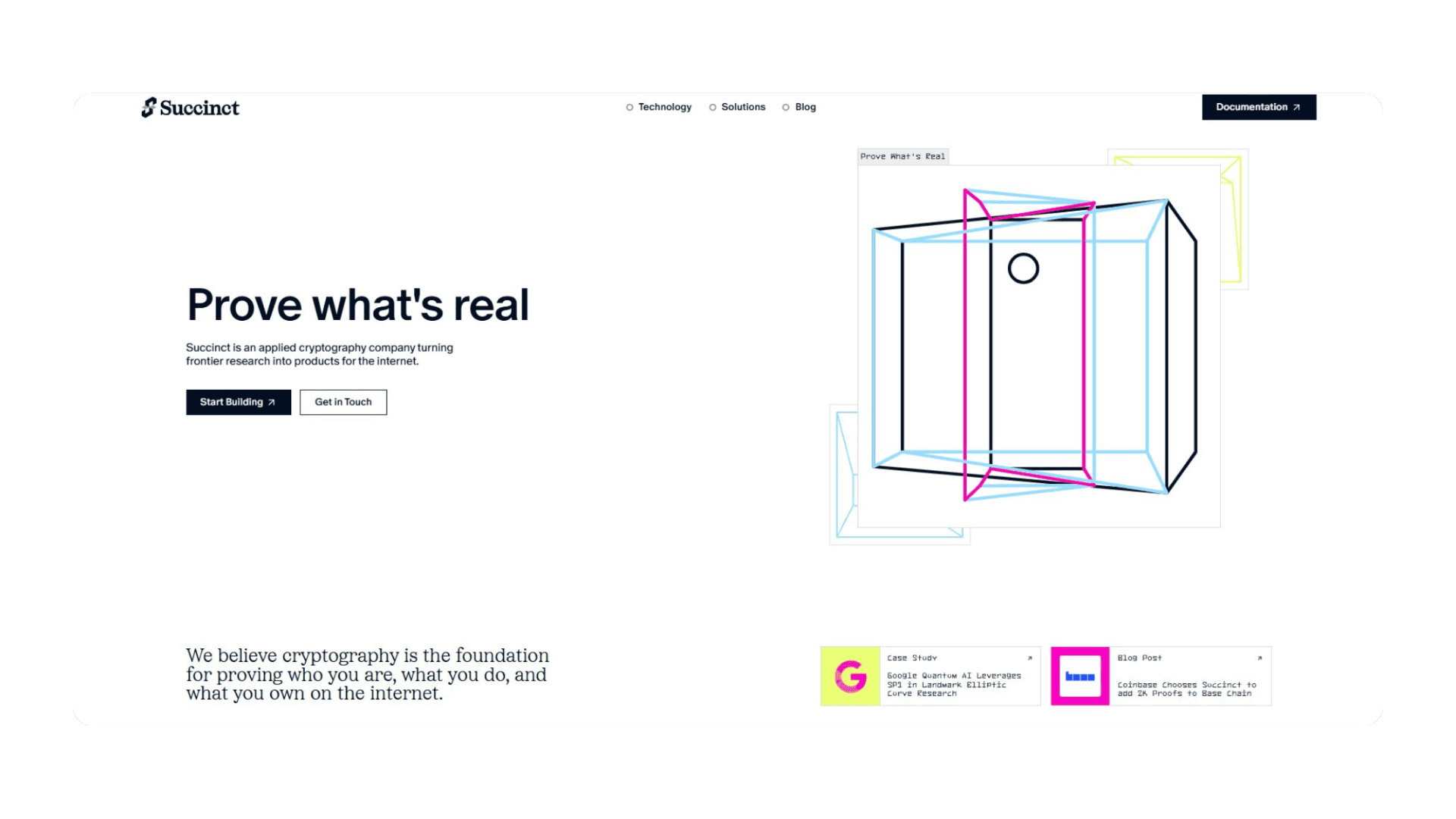
Succinct Labs built SP1, a general-purpose zkVM running over RISC-V. Around 90% of the rollup proving market runs on SP1, including Optimism, Base, and Unichain. Their Prover Network, backed by a $PROVE token and launched in 2025 after a $55M Series A led by Paradigm, decentralizes proof generation so projects don't need to own GPU infrastructure. SP1 Hypercube is the current performance frontier: roughly 10 seconds per Ethereum block proof at around $0.02 per proof, on hardware that costs $24–48K to own rather than $300–400K.
RISC Zero takes a similar zkVM approach (write Rust programs, get ZK proofs of execution) and has a different economic model. Their Boundless marketplace, live on mainnet since September 2025, has processed 542 trillion cycles and 399K orders. R0VM 2.0 dropped block proving time from 35 minutes to 44 seconds. They claim 7x lower cost than SP1, though benchmark comparisons between proving systems are notoriously dependent on workload type.
Irreducible is the one to watch for the medium term. They're building Binius, a proof system that operates over binary fields instead of the large prime fields used by most SNARKs and STARKs. The practical implication is that binary computation, which is how CPUs actually work, can be proven much more directly, targeting 10–100x efficiency improvement over prime-field proofs. Vitalik Buterin wrote a detailed explainer on it. Polygon Labs is partnering on a Binius-based zkVM. $39M raised from Paradigm and Bain Capital Crypto, and still in research-to-production development.

Ingonyama is doing hardware acceleration via ICICLE, an open-source GPU acceleration library for ZK provers. If you have a proof system and want it to run faster on GPUs without rewriting your cryptography, ICICLE is the library. They're also building FPGA and custom silicon implementations. The $21M seed from IOSG, Walden Catalyst, and Samsung Next reflects a bet that proving costs will continue to drop as specialized hardware catches up.
Rollups: The L2 Battlefield
The major zkEVM rollups are past the "will this work" phase and into the "how fast, how cheap, and for whom" phase.
Matter Labs is probably the most ambitious bet in the space right now. $458M raised, and the 2026 roadmap points clearly at institutional finance. Prividium, their private permissioned blockchain for regulated financial institutions, has five U.S. banks representing over $600B in deposits building on it through Cari Network. The Elastic Chain vision (multiple application-specific ZK chains sharing a common proving layer, interoperating natively) is becoming real: ZIP-16 introduced native cross-chain token transfers between ZKsync chains in May 2026, with fees denominated in $ZK. This is no longer just a scaling play; it's infrastructure for compliant institutional DeFi.
StarkWare invented STARK proofs and remains the only major L2 team that is also the research origin of its proof system. Starknet is the production rollup; StarkEx is the permissioned scaling engine behind dYdX, Immutable X, and Sorare. The $8B valuation from the Series D in 2022 looked aggressive at the time. What's notable is the post-quantum angle: STARKs are hash-based and carry no elliptic curve dependency, which makes them resistant to future quantum attacks in a way that SNARK-based systems are not. That argument has gotten louder as quantum computing timelines have shortened.
Aztec Network is the one doing something the others are deliberately not doing: privacy by default. Most ZK rollups use zero-knowledge proofs for scaling: the validity proof proves the computation was correct, but the transactions themselves remain visible on Ethereum. Aztec's architecture separates private execution (done locally on the user's device via PXE) from public settlement (submitted to Ethereum). Contracts can define exactly which data is public and which stays private, and those privacy rules compose across contract calls. Mainnet launched in November 2025. The token generation event happened in February 2026. Full private smart contract execution is rolling out through 2026. Backed by a16z and Paradigm with over $180M combined equity and token rounds.
Polygon is the largest ZK ecosystem by capital deployed, $451M in funding plus a $1B+ ZK treasury, and also the most fragmented. Polygon zkEVM is the main production rollup (sub-2.5 second confirmation, $0.015 average fee). Polygon Miden is a STARK-based VM with a distinct design philosophy. Polygon Zero uses recursive proofs. The acquisition of Toposware in 2024 and the $5M purchase of Fabric VPU hardware signals continued infrastructure investment. The risk with Polygon's ZK story is the breadth: three separate ZK product lines with different proof systems require a lot of engineering coordination to maintain and differentiate.
Privacy Blockchain Development: Applications Layer
Zcash matters because it has ten years of production ZK-SNARK deployment, which no one else can claim. The Halo 2 upgrade removed the trusted setup requirement that had been a persistent criticism of the original Groth16 proofs. The shielded pool crossed 4.5M ZEC in late 2025. Market cap surged past $6.3B. For teams evaluating privacy blockchain development in financial contexts, Zcash is the only project with a decade-long track record of ZK proofs in production under adversarial conditions.
Worldcoin / World is the largest real-world ZK deployment by user count: over 10 million people verified as unique humans via iris scan, with ZK proofs ensuring the biometric data never leaves the Orb. Whether or not you have opinions about the project's approach to identity, the engineering is real and deployed at a scale no other ZK application has reached.
ZK Proof Services: Development Partners
Most of the companies above are building protocols, infrastructure, or applications on their own roadmap. If you're a company that wants to integrate ZK into your product (a private voting system, a confidential DeFi protocol, a compliance tool that proves regulatory requirements without exposing user data), you need a different kind of partner.
Rumble Fish sits in this category. The Kraków-based team works across the full ZK development stack: custom circuit design using Circom, Noir, gnark, and arkworks; rollup implementations; privacy-preserving smart contracts; and integration into production systems. The work is concrete: they built a decentralized registry using zero-knowledge cryptography for Original Works, reducing ZK proof processing time significantly using RISC Zero and Rust. The ZKP service covers zk-SNARKs for shielded transactions, zk-STARKs for scalable proofs, and PLONK-based systems, which is a broader proof system coverage than most development shops maintain.
What distinguishes a ZK development partner from a ZK protocol company is scope. Protocol companies own their infrastructure and build on their own timeline. A development partner works within yours, translating a product requirement into a proof system architecture and delivering a working implementation. For teams that don't want to hire a cryptography department, this is the practical path to shipping ZKP functionality.
How to Read This Landscape in 2026
The question of which ZKP development company to work with depends on what you're actually trying to build. If you need a production ZK rollup for Ethereum scaling, the zkEVM options (zkSync Era, Scroll, Polygon zkEVM) are mature enough to evaluate seriously on their developer experience, ecosystem, and fee structure rather than proof system stability.
If privacy is the primary requirement, not just as a side effect but as the core feature, Aztec is the only production system designed around it from the start. The privacy vs. regulatory compliance tension is real and unresolved at the protocol level, but the cryptography works.
If you're building something that generates ZK proofs as part of a larger application (not a rollup, but a compliance tool, a voting system, a confidential data product) the proving infrastructure from Succinct or RISC Zero makes self-hosted proof generation cheaper than it has ever been. Whether you build on top of that infrastructure yourself or engage a ZK development partner depends on how much cryptographic expertise you can justify building in-house.
The consolidation that has happened in the last 18 months is real. The theoretical layer is largely settled. What's left is engineering, adoption, and the slow process of proving that ZK proofs can carry the compliance and privacy requirements of regulated industries: not just in test environments, but in production, under audit, with real money moving through them.
Recent posts